[ Our Home Page ] [ Online Catalog ] [ Garlic Overview ] [ 40 Varieties ] [ Growing Garlic ] [ Cooking with Garlic ] [ Chemistry of Garlic ] [ Garlic Pills & Oils, Etc. ] [ Health Benefits ] [ Links ] [ FAQ's ] [ How to Order ]

[ Sampler Assortments ] [ Pickle & Preserve Garlic ] [ Artichoke (Softneck) Garlics ] [ Asiatic Garlics ] [ Creole Garlics ] [ Porcelain Garlics ] [ Purple Stripe Garlics ] [ Rocambole Garlics ] [ Silverskin (Softneck) Garlics ]

[ Pickled Snacks ] [ Growing Garlic in the South, CA & Texas ] [ Tour our Garlic Garden ] [ Paint Rock Pictographs ] [ Newsletter ] [ Garlic is Life Symposia ] [ Good Growers Wanted ] [ About Us ] [ Spring 2001 ] [ Spring 2007 ]


Artichoke Varieties

We expect to have a full selection of Artichoke garlics this year. -
Updated March 2, 2008 -


Picture of Simoneti Garlic


Find out who your friends really are, eat garlic!


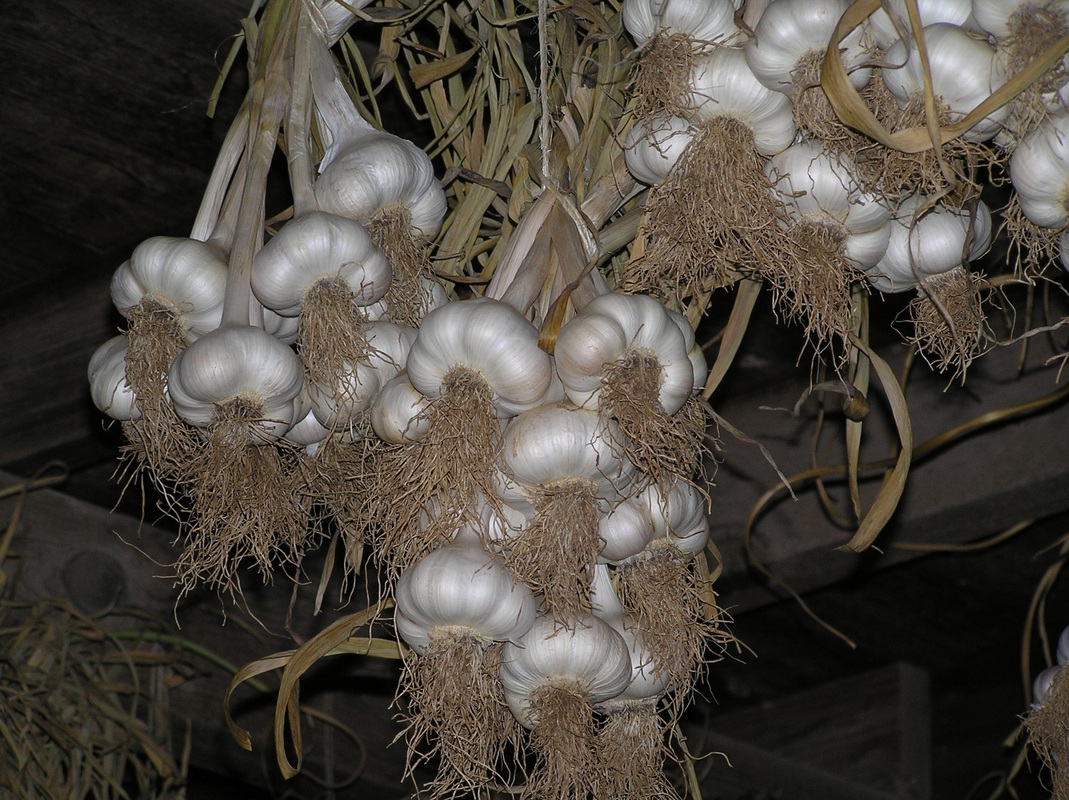
Artichoke garlics (sativums or softnecks) are the kinds of garlics seen most in the supermarkets in our part of the country. California Early and California Late are grown in huge quantities around Gilroy, California and shipped all over the country and are the generic garlic that most people think of when they think of garlic. In fact, most people around our parts weren't even aware that there was more than one kind of garlic. Artichoke garlics are the easiest to grow and seem to be less fussy about growing conditions than the others and do well in warm winter locations. They have lots of cloves, usually somewhere between 12 and 20, with lots of smaller internal cloves. These are a favorite among people who want to use only a very small amount of garlic in a dish (although I can't imagine why). They appear to feel that if you can taste the garlic in a dish you have used too much and prefer to use the small inner cloves.

Artichokes are generally very large, store well and have a wide range of flavors with some, like Simoneti and Red Toch, being very mild and pleasant and others, such as Inchelium Red and Susanville, have greater depth of flavor. Chinese Purple and Purple Cauldron are much stronger and stick around for a while. The Asiatic group of artichoke garlics tend to send up scapes, despite the fact that they're supposed to be softnecks and have a little more color to the bulb wrappers than the main group, which are usually very white. The Turban group of artichoke garlics tend to be the most colorful artichokes and have fewer cloves per bulb than the others. The turbans also harvest earlier and store less long than the other artichokes and a good bit stronger in taste as well.

Artichoke Garlics are the commercial growers favorite because they are easier to grow and produce larger bulbs that most other garlics. Artichokes are often called red garlics or Italian garlics despite the fact that most are neither red nor were ever grown in Italy. Most of the artichokes that have red as part of their name have no red in them, but we retain the word as it helps to describe exactly which cultivar we are discussing.

- Weather-related crop damage will somewhat limit Artichoke Garlic Availability in 2007.
Next year there will be more kinds available. -

Inchelium Red
Picture of Inchelium Red garlic
Harvests mid-season - stores 6-7 months.
Grows very well in warm winter areas.


- Order Now for fall 2008 delivery. -

Choose Inchelium Red Size/Price


May we substitute if we are out of this variety?


Quantity:
After ordering, use your back arrow key to return to this point, otherwise the shopping cart will return you to our home page.

- . - Harvests mid-late season - stores 6-7 months.

lnchelium Red is a large and beautiful artichoke garlic with delightfully robust flavor but not so strong as to be overpowering. In 1990 Rodale Kitchens, part of the parent organization of Organic Gardening magazine, sponsored a garlic tasting contest. Inchelium Red won the contest. The verdict was not unanimous, of course, as people's tastes vary widely, but it won anyway. It is among our best selling artichoke garlics most years.

Inchelium Red is my benchmark garlic for true medium. I compare the tastes of all garlics as being milder or stronger than Inchelium Red. It has medium rich garlickness and medium pungency, or, hotness when eaten raw. On a scale of 1 to 10 on flavor and taste, it gets a 5 in each category.

From a growers perspective, it is a large and healthy garlic to grow and appears to be relatively resistant to most of the diseases that can affect garlic. Its true origin is unknown as it was discovered growing on an Indian reservation and no one seems to know where it came from.

Inchelium Red usually has anywhere from 12 to 20 cloves and is large enough that even the interior cloves are generally of good size. The outer bulb wrappers are thick and protect the bulb well so it is a good storer but still peels easily. For those who want to grow their own garlic it has enough cloves that it doesn't take but a year or two to grow all you can eat. It harvests in mid-season (late for an artichoke) and takes a little longer than average to cure due to its large size. Bulbs are usually over 2 and a half inches in diameter and will weigh several ounces each.

Red Toch

Picture of Red Toch garlic
Harvests early in season - stores 6-7 months.
Grows very well in warm winter areas.


- Order Now for fall 2008 delivery. -

Choose Red Toch Size/Price


May we substitute if we are out of this variety?


Quantity:
After ordering, use your back arrow key to return to this point, otherwise the secure shopping cart will return you to our home page.
- Order Now for fall 2008 delivery. -

Red Toch is another one of those delightful garlics originally from the Republic of Georgia in the former USSR. This tiny country seems to have developed more garlics than everyone else put together. Red Toch is a nicely flavored garlic, a bit on the mild side and with very little heat. It is not quite as mild as Chet's and not quite as strong as Inchelium Red. The inner bulb wrappers have a little rosy pink coloration and are of medium thickness and easy to peel. Red Toch averages fairly large bulbs that are a little larger than Chet's but not as large as Simoneti or Inchelium Red. It generally grows fairly clean under good conditions and has a few smallish inner cloves but not tiny ones. It, too, likes to finish off its growing season somewhat on the dry side, otherwise bulb wrappers can split.

Chester Aaron in his books Garlic is Life and The Great Garlic Book, a guide with Recipes has well deserved praise for this garlic. Its fame has also spread from the Victory Garden series on Public Television. It is good for a garlic to gain a reputation for its flavor rather than its pungency. There's more to garlic than raw power, you should at least like the taste of what you eat. Some cultivars are so strong it's hard to tell whether they have any flavor or not. It's good to see this very nice garlic get some respect in a world of power hitters.

On my dual scale it ranks a 3-4 for garlickiness and a 1-2 for pungency. Semi-rich but very mellow.

I had dinner with Chester Aaron and about 30 garlic experts in Tulsa one evening at a posh supper club that was elegant in every way. There were whole bulbs of Red Toch all up and down the linen tableclothes amid the candles and fresh flowers and all the Sterling and stemware and these scientists and a few of us ordinary folk broke those bulbs apart and ate them as appetizers with French bread and butter and with bulb wrappers everywhere, surrounding diners were invited to enjoy the feast - and did. Since eating garlic makes you feel good, literally, a great time was had by all, including the surrounding diners as memories that will last a lifetime were made that night. The chef appreciated the education he got in garlic that night.

It usually grows rather well for us here in central Texas and is one of our family's favorites, especially for raw eating. An old Filaree Farm catalog says its raw taste has been described as the perfect garlic taste. I don't know about that as I hope I haven't yet tasted the perfect garlic taste, but I do know that I like it and we will continue to grow it and use it at home. It is really nice to be able to have a wide variety to choose from as one's taste varies from day to day and even from meal to meal, so buy a few and try them and be sure to save some for planting this fall. It is a very early maturing garlic and is one of the first cultivars we harvest each year.

California Early Picture of an Artichoke garlic

Harvests Mid-late season - stores 6-7 months.
- - Probably Available in 2008. - -

- ProbablyAvailable in 2008. -
After ordering, use your back arrow key to return to this point.

This one of the two Gilroy cultivars is the one you're least likely to find in the local supermarkets because it is processed into dried and pickled and otherwise processed garlic products. California Early is a little bigger and sweeter than California Late, which is definitely on the hot side. Cal Early is said to be very early maturing but it seems to be more of a mid-artichoke-season garlic for us, though it is a prolific grower and a good commercial garlic. It does seem to tolerate our hot spring weather well and stores well also.

I was pleasantly surprised by how much better our Cal Early garlic was than the ones we bought in the stores. The difference our healthy soil and careful handling makes is phenomenal.When grown and harvested properly, Cal Early is an excellent all- around general use garlic and a wonderful baker.

It ranks 4-5 on the garlickiness scale and 3-4 on the pungency side. It has a semi-rich flavor and a little bite, but is still on the light side.

It's a very good growers garlic as it has many large cloves (even the innermost cloves are of good size) and it stores well under proper conditions. The Gilroy growers knew good garlic when they saw it, it was their agricultural practices and resulting soil conditions that made the difference.

Applegate - a mild and mellow artichoke garlic.

Picture of actual Simoneti garlic Harvests in early-mid season season - stores 6-7 months.
- Sorry, probably Not Available in 2008. -

After ordering, use your back arrow key to return to this point.
- Sorry, probably Not Available in 2008. -

Applegate is an excellent mild garlic that is excellent for raw eating or cooking where you want only the most delicate hint of garlic in your dish.

Extremes of weather, such as extra cold or dry winters or high temperatures in the early spring can make it a warmer and stronger garlic. It is a wonderful garlic and I highly recommend it for those who love good tasting mild garlic. It is well worth growing and is a fairly early maturing garlic which you can be enjoying while most of the others are still in the ground.

Applegate is a good garlic to grow in warm winter areas.

Early Red Italian Picture of an Artichoke garlic

Harvests early in season - stores 6-7 months.
- - May or May Not be Available in 2008. - -

After ordering, use your back arrow key to return to this point.
- May or May Not be Available in 2008. -

Early Red Italian has long been a gardeners favorite because it is an early harvesting , richly flavored light-to medium pungency garlic that has a lot of color and grows almost anywhere. That's a lot to like in a garlic that when properly grown and stored will keep through the winter. After a few months of having no garlic, Early Red Italian gave gardeners an excellent garlic weeks before most other varieties and it is a prolific grower and a good commercial garlic. It matures after the mild Red Toch and before Inchelium Red, which is a little stronger most years. It does seem to tolerate our hot spring weather well and stores well also.

Early Red Italian ranks 4-5 on the garlickiness scale and 3-4 on the pungency side. It has a semi-rich flavor and a little bite, but is still on the light side.

The difference our healthy soil and careful handling makes is phenomenal in all garlics. When grown and harvested properly, Early Red Italian is an excellent all- around general use garlic and an excellent baker. It's a very good growers garlic as it has many large cloves (even the innermost cloves are of good size) and it stores well under proper conditions.

Lorz Italian - An Excellent Heirloom Garlic . -

Picture of an Artichoke garlic

Excellent strong garlic for warm winter gardeners.


Harvests mid season - stores 6-8 months.
- Order Now for delivery in late summer/early fall 2008. -

Choose Lorz Italian Size/Price


May we substitute if we are out of this variety?


Quantity:
After ordering, use your back arrow key to return to this point, otherwise the secure shopping cart will return you to our home page.
- Order Now for delivery in late summer/early fall 2008. -

This medium-large Italian artichoke is unusual in several ways; color, taste and storability. Lorz has more purple in the bulb wrappers than one usually sees in an artichoke and the semi-thick wrappers peel easily away revealing large cream-colored cloves with elongated tips and only the faintest hint of purple. It harvests in mid season and stores very well until winter. It averages seven large fat cloves in three clove layers and usually has no small internal cloves.

It ranks 4-5 on the garlickiness scale and 8 on the pungency side. It has a semi-rich flavor and a lot bite that just increases with age and it stores well for 6-8 months.

Most Italian garlics tend to be somewhat mild, but this one is different. Depending on growing conditions, it can be very hot and strong. At first, it doesn't seem to have any aftertaste at all - then in a few minutes it begins to grow and becomes very noticeable and builds to a peak in about thirty minutes. If you like garlic with a bold flavor that really sticks around, this is for you. In years where the taste is milder due to growing conditions, the aftertaste is still strongly present, even though the initial taste is milder. A real garlic lovers garlic.

Thermadrone - an artichoke garlic from France

Picture of actual Simoneti garlic Harvests in early-mid season season - stores 6-7 months.
- Sorry, not available in 2008. -

Thermadrone is an excellent mild artichoke that adds to our collection of French garlics (Creoles) for authenticity in French cooking - next year we hope to add a silverskin

Extremes of weather, such as extra cold or dry winters or high temperatures in the early spring can make it a very hot and strong garlic. It is a wonderful garlic and I highly recommend it for those who love good tasting mild garlic. It is well worth growing and is a fairly early maturing garlic which you can be enjoying while most of the others are still in the ground.

Simoneti Picture of actual Simoneti garlic

Harvests in mid-season - stores about 6 months.
- Probably Not Available in 2008. -

- Probably Not Available in 2008. -

Despite its Italian sounding name this large, clean, wonderfully mild garlic originated in the Republic of Georgia, a southern former USSR country, as have so very many cultivars-these people know and love garlic. Simoneti may well be my own personal favorite for raw eating. On the average, they're huge and solid and grow extremely clean and free from fungus, molds, etc. that can plague many others. The flavor is definitely garlicky, but with minimal aftertaste and heat. This gentle giant is great for those who like it mild but with full flavor. If strong garlic upsets your stomach, try this one instead. Simoneti has thick, very white bulb wrappers that are easy to peel and it stores well. Even the inner cloves are of good size. It is another grower's delight as it has many large plantable cloves (12 to 18 or more) and you can build up your garden with it in only a season or two. Simoneti has a very thick neck and is very large leafed and has a rather roundish shape. If you like it as much as I do, you will want to get a few extra for planting this fall. As with other large artichoke garlics it harvests in mid-season (one of the latest artichokes) and takes a little longer than average to cure due to its large size.

California Late Picture of an Artichoke garlic

Harvests Mid-late season - stores 6-7 months.
- May or May Not be Available in 2008. -

After ordering, use your back arrow key to return to this point.
- May or May Not be Available in 2008. -

One of the two cultivars you're most likely to find in the local supermarkets, along with California Early. California Late is a little on the hot side and has more color. Cal Late is more of a mid-late season garlic for us, though it is a prolific grower and a good commercial garlic. It does seem to tolerate our hot spring weather well and stores well also. I was pleasantly surprised by how much more flavor our Cal Late garlic was than the ones we bought in the stores. The difference our healthy soil and careful handling makes is phenomenal.When grown and harvested properly, Cal Late is an excellent all- around general use garlic and a wonderful baker. It's a very good growers garlic as it has many large cloves (even the innermost cloves are of good size) and it stores well under proper conditions. The Gilroy people choose their garlic well, they just didn't grow it well. Great garlic became a casualty of modern farming, but rightful growing can restore it to its place of dignity.


Siciliano Picture of an Artichoke garlic

Harvests mid season - stores about 6 months.
Siciliano - Available in assortments only. -


After ordering, use your back arrow key to return to this point.
Siciliano - Available in assortments only. -

Siciliano is a white garlic that is a feast to the eyes as well as the palate and stores well also and that's asking a lot of a white garlic. The rich flavor is a bonus. Sicilano is a white garlic that has a pearly lustre to it. It has a rich flavor with a zesty medium pungency and a crisp, crunchy texture that is like a water chestnut with taste and an attitude. Its richness makes it excellent for raw eating as in pesto, salsa or just to have something crunchy to munch on with a sandwich, instead of the usual chips. Being an Artichoke garlic, Siciliano is adaptable to a wide range of climates and is a good garlic for growing in warm winter areas.

How Our Garlics are Grown

For the last 14 years our garlic has been grown about 12 miles SW of Bangs (near Brownwood) in West-central Texas. We live on a working cattle ranch and have an old family garden plot where our garlic has been grown without the use of any toxic chemical pesticides or herbicides or artificial fertilizers and in rotation with vegetables we grow for family use and sometimes for the local farmers markets.

This year we will be planting for harvest in 2008 in a field we have been developing for three years now. It's a 30-acre field just North of our house but we will be growing only in 2-3 acres at a time so we will have plenty of room to rotate crops. I'll have to run a water line from the creek and a power line from the house so we can irrigate. I'll also have to fence it off to keep the cattle from trampling the garlic. There's a lot more to it than just throwing a few cloves of garlic in the ground.

This year we will offer some of the garlic we have grown (mostly for warm winter area gardeners) and also other sustainable and organic growers have made their finest produce available for us to sell. They all know to send me only their best, because I will neither buy nor sell any lesser quality garlic. Besides, I pay these growers their price and they are rightfully proud of their garlic. Those I continue to be impressed with are the ones I buy from. If our garlic isn't the best in the country, I'd like to find out what is, 'cause I would like to buy some of it.

All of our growers are sustainable, earth-friendly growers and we won't buy from those who use conventional agricultural chemicals or fertilizers. Most are either Certified Organic or Certified Naturally Grown or Certified Biodynamically grown, but all are sustainable growers, whether certified or not. Most of the smaller growers are not certified at all but live a sustainable lifestyle and believe in what they're doing. I simply take their word for it because I believe them after conversing with them and wish to reward such a conscientious lifestyle.

It is true sustainability, not just the appearance of it, that we are supporting here; it's the difference between governments and gardeners. Gardeners and small commercial growers trust each other because they know they can and governments and other large organizations, don't trust because they know they can't. I'm on the side of the gardeners and small growers and the public at large here, the big 'uns will have to look out for themselves.

I have discussed this topic with many customers and the vast majority have told me in phone calls, emails, etc. that it was more important to get garlic that was really sustainably grown garlic than that which only claimed to be on the label. The Certified Organic label used to assure that but in recent years the NOP rules have been watered down to allow large organizations to label as organic, things which would not have been allowed originally. The Certified Organic label has become a bureaucratic burden on the small producer who cannot afford to hire an office staff to do all the required paperwork and many are looking to alternative certification that is more stringent in sustainability requirements and less demanding of paperwork.

We accept all these sustainably grown garlics on an equal basis so long as the bulbs themselves are healthy bulbs that appear and smell good in every way. For us, true sustainability is most important thing.

Many of our growers are Certified Organic and are among the best available sources of Certified Organic Garlic and we will happily fill your order with garlic from them at no extra cost if you ask for Certified Organic in the comments section of our online order form . You will get healthy, pesticide-free garlic grown with the old-fashioned natural fertilizers in any event, but if you require Certified Organic or any other particular certification, please let us know so we can provide only that.


Bob Phillips' Texas Country Reporter did a story on me and the garlic for their long running TV program -
click here to see the 6:28 video on youtube:


Picture of the Garlicmeister playing his Indian flute.

Bob Anderson
Garlicmeister, a self-inflicted title for amusement only.
Photo courtesy of Bill Yeates.

[ Our Home Page ] [ Online Catalog ] [ Garlic Overview ] [ 40 Varieties ] [ Growing Garlic ] [ Cooking with Garlic ] [ Chemistry of Garlic ] [ Garlic Pills & Oils, Etc. ] [ Health Benefits ] [ Links ] [ FAQ's ] [ How to Order Garlic ]

[ Sampler Assortments ] [ Pickling & Preserving Garlic ] [ Artichoke (Softneck) Garlics ] [ Asiatic Garlics ] [ Creole Garlics ] [ Porcelain Garlics ] [ Purple Stripe Garlics ] [ Rocambole Garlics ] [ Silverskin (Softneck) Garlics ]

[ Pickled Snacks ] [ Growing Garlic in the South, California & Texas ] [ Tour our Garlic Garden ] [ Paint Rock Pictographs ] [ Newsletter ] [ Garlic is Life Symposia ] [ Good Growers Wanted ] [ About Us ] [ About Our Place ]

Our site is always under construction. --This page last updated March 5, 2008.
If you would like to communicate with us, please send email to: Bob - (bob@web-access.net)

Our website been visited by over a million times by people looking for good garlic
and up to date garlic information since August of 1997.
Thanks one and all.